Why SMBs Outsource IT Support: The Real Reasons

Outsourcing IT support is the practice of hiring an external managed service provider (MSP) to handle some or all of a company’s technology operations, and for small and medium-sized businesses, it is the most cost-effective path to professional-grade IT without the overhead of a full internal team. The reasons SMBs outsource IT support go well beyond saving money. Cybersecurity complexity, talent shortages, and the pressure to adopt AI-driven tools are forcing business owners to rethink how they manage IT entirely. 52% of SMBs rely on untrained staff or business owners to handle critical security functions, which is not a sustainable model. The shift toward managed services is accelerating, and the businesses that act on it now are building a measurable operational advantage.
Why SMBs outsource IT support: the financial and operational case
The most direct reason SMBs choose outsourced IT support is cost control. Outsourcing IT converts fixed overhead into variable expense, meaning you pay only for the services you actually need rather than carrying a full-time salary, benefits, and training costs for an in-house technician. Predictable monthly fees make budgeting straightforward, which matters enormously when you are managing tight margins.
The break-fix model, where you call someone only when something breaks, sounds cheaper until you calculate the cost of downtime. A single server outage during peak retail hours can cost a small business thousands of dollars in lost sales and staff productivity. Managed services beat break-fix because they shift the incentive structure: your MSP is motivated to prevent problems, not just fix them after the damage is done.

Talent gaps compound the financial problem. Hiring a qualified IT professional in New York or Florida means competing with enterprise salaries. An MSP gives you access to a team of specialists, from network engineers to cybersecurity analysts, at a fraction of that cost. The result is faster issue resolution, less unplanned downtime, and IT costs that scale with your business rather than against it.
Model | Cost structure | Expertise level | Response time |
In-house IT team | Fixed salary + benefits | One generalist | Business hours only |
Break-fix contractor | Per-incident billing | Variable | Reactive, often slow |
Managed service provider | Predictable monthly fee | Specialist team | 24/7 monitoring |
Pro Tip: Before signing with an MSP, ask for a sample monthly report. If they cannot show you what proactive monitoring looks like in practice, you are buying reactive support with a managed services label.
How skill and capacity gaps push SMBs toward outsourced IT
Cybersecurity is increasingly a capacity problem for SMBs, not just a skills shortage. Even business owners who understand basic security principles do not have the hours in the day to monitor networks, patch systems, respond to alerts, and stay current on evolving threats. The volume of daily threat activity has grown to a point where part-time attention is functionally the same as no attention.
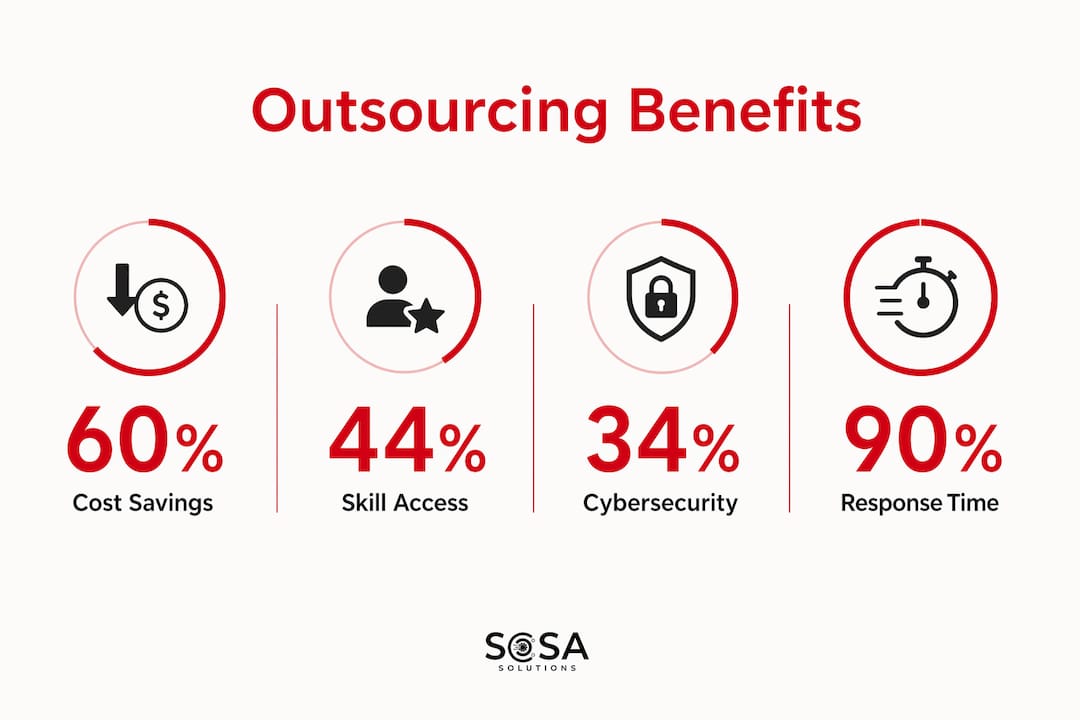
The numbers confirm this. Only 34% of SMBs have formal incident response plans developed with cybersecurity professionals. That means two-thirds of small businesses are improvising when an attack happens, which is exactly when improvisation is most dangerous. Contrast that with the finding that 80% of SMBs with a formal incident response plan avoided major damage during cyberattacks. Preparedness is the differentiator, and MSPs deliver it systematically.
The operational fragmentation problem is just as serious. Many SMBs run a patchwork of tools: a cloud storage provider here, a point-of-sale system there, a VoIP phone system managed by someone who left the company two years ago. No single person owns the full picture. An MSP maps that environment, closes the gaps, and provides continuous monitoring that no part-time internal resource can replicate.
Key capacity gaps that drive SMBs to outsource IT support:
24/7 monitoring. Threats do not follow business hours. Internal staff cannot provide round-the-clock coverage without significant cost.
Incident response. Responding to a breach requires a documented plan, trained personnel, and tested procedures. Most SMBs have none of these.
Patch management. Unpatched software is the entry point for the majority of ransomware attacks. Consistent patching requires dedicated time and tooling.
Compliance tracking. Regulations like HIPAA, PCI-DSS, and state-level data privacy laws require ongoing documentation that internal generalists rarely maintain properly.
“Fear of cyberattacks and customer responsibility are top drivers for MSP use among SMBs.” — Guardz 2025 SMB Cybersecurity Report
What managed IT services offer beyond cost savings
The KPMG 2026 Managed Services Outlook frames outsourcing not as a cost-cutting tactic but as an operational backbone for scaling AI and digital transformation. That framing matters because it redefines what you are buying. You are not just purchasing someone to fix your Wi-Fi. You are buying the capacity to adopt new technology without the planning paralysis that kills most SMB tech initiatives.
81% of SMBs report being unprepared for AI-driven threats, which has directly increased demand for MSPs that offer AI-powered detection and response. The threat environment has outpaced what any generalist internal hire can handle. MSPs that specialize in AI-augmented monitoring can detect anomalies in minutes rather than days, which is the difference between a contained incident and a full breach.
Beyond security, managed services provide four capabilities that directly enable SMB growth:
Technology adoption without internal expertise. Want to migrate to Microsoft 365, deploy a new POS system, or set up a hybrid cloud environment? An MSP handles the planning, execution, and ongoing management so your team focuses on the business.
Regulatory compliance support. MSPs with compliance specializations help SMBs meet PCI-DSS, HIPAA, or CMMC requirements without hiring a dedicated compliance officer.
Scalability on demand. Opening a second location or adding 20 employees does not require a new IT hire. Your MSP scales the service level to match your growth.
Business continuity planning. Backup, disaster recovery, and failover systems are standard in most managed service agreements, giving SMBs enterprise-grade resilience.
Pro Tip: Ask any MSP candidate whether they offer outcome-based service tiers. 44% of SMBs are willing to pay more for AI-powered detection and response. If your MSP cannot articulate what outcomes they guarantee, you are paying for effort, not results.
How SMBs should handle accountability and compliance when outsourcing IT
Outsourcing shifts the work but not the accountability. This is the most misunderstood aspect of managed IT services, and it catches SMBs off guard during audits. Even with MSPs managing monitoring and tools, your business retains responsibility for governance and compliance outcomes. The MSP is a contractor. The regulatory obligation stays with you.
The shared responsibility framework defines which controls the MSP owns and which you retain. Without a documented matrix, compliance gaps appear. Without a clear shared responsibility matrix, SMBs risk audit failures and regulatory penalties even when their MSP is performing well technically. This is especially relevant for businesses operating under CMMC, HIPAA, or PCI-DSS frameworks.
Practical steps to protect your compliance position when outsourcing:
Demand a written shared responsibility matrix before signing any MSP contract. Every control should be assigned to either the MSP or your internal team, with no ambiguity.
Define escalation paths in writing. Who gets called at 2 a.m. when a breach is detected? What is the response time commitment? These details belong in the contract, not in a verbal agreement.
Require regular compliance reporting. Monthly or quarterly reports should document patch status, incident logs, access reviews, and any open vulnerabilities.
Clarify data processing scope. If your MSP touches customer data, their systems may fall within your compliance scope. Know this before you sign.
Compliance area | SMB responsibility | MSP responsibility |
Governance and policy | Owned by SMB | Advisory support |
Technical monitoring | Delegated to MSP | Primary owner |
Incident documentation | Shared | MSP provides logs |
Audit evidence | SMB must produce | MSP provides data |
Regulatory filings | Owned by SMB | No direct role |
What to look for when selecting an MSP for your SMB
Choosing the right MSP is a business decision, not just a technical one. The wrong partner creates dependency without accountability. The right one becomes an extension of your operations. Start by assessing whether the MSP has verifiable experience with businesses in your industry and size range. A provider that primarily serves enterprise clients will not prioritize a 15-person retail operation the same way a specialized SMB-focused MSP will.
Certifications matter, but context matters more. Look for MSPs holding CompTIA Managed Services Trustmark, SOC 2 Type II certification, or relevant compliance credentials like HIPAA Business Associate Agreement capability. These are not just credentials. They signal that the provider has been audited against real standards.
Key criteria for evaluating MSP candidates:
Response time guarantees. Verify that SLAs specify resolution times, not just acknowledgment times. Knowing your ticket was received is not the same as having your problem solved.
Local versus remote support balance. Some issues require physical presence. An MSP with no local technicians in your market is a liability for hardware failures, store openings, or infrastructure upgrades. Sosasolutionsnyc covers New York and Florida with both on-site and remote capabilities, which is the model worth benchmarking against.
References from comparable businesses. Ask for two or three client references in your industry. A provider unwilling to supply them is telling you something.
Contract flexibility. Avoid multi-year lock-ins without performance benchmarks. Your service level should be reviewable at least annually.
Reviewing performance regularly is not optional. Set quarterly business reviews with your MSP where you examine ticket volume, resolution times, security incident summaries, and upcoming technology needs. This keeps the relationship accountable and prevents the drift that turns a good MSP engagement into a passive, underperforming contract.
Key takeaways
SMBs outsource IT support because internal capacity, cybersecurity expertise, and technology complexity have all exceeded what most small businesses can manage alone, and managed service providers close that gap at a predictable, scalable cost.
Point | Details |
Cost structure advantage | MSPs convert fixed IT overhead into variable expense, improving budget predictability. |
Cybersecurity capacity gap | 52% of SMBs rely on untrained staff for security, creating serious exposure that MSPs resolve. |
Compliance accountability | Outsourcing delegates tasks but not regulatory responsibility. Demand a shared responsibility matrix. |
Managed services beyond cost | MSPs enable AI adoption, compliance support, and scalability that in-house teams cannot match. |
MSP selection criteria | Prioritize certifications, local support capability, and contract flexibility over price alone. |
What I have learned from watching SMBs get outsourcing wrong
Most SMBs that struggle with outsourced IT support made the same mistake: they treated the MSP selection like a commodity purchase. They compared monthly fees, picked the lowest number, and assumed the work would happen. It rarely does, at least not at the level they needed.
The businesses I have seen get real value from outsourcing shared one trait. They treated the MSP relationship like a hire, not a vendor contract. They defined expectations before signing, reviewed performance regularly, and pushed back when service levels slipped. That posture changes everything about how an MSP prioritizes your account.
The other misconception worth addressing directly is that outsourcing means losing control. The opposite is true when done correctly. A well-structured MSP agreement with clear reporting, defined escalation paths, and documented responsibilities gives you more visibility into your IT environment than most SMBs have with internal staff. You get dashboards, incident logs, and monthly summaries that an overwhelmed internal generalist would never produce.
The SMBs that grow through IT partnerships are not the ones with the biggest budgets. They are the ones that ask the right questions before signing and hold their partners accountable after.
— Christopher
How Sosasolutionsnyc supports SMBs in New York and Florida
Sosasolutionsnyc delivers managed IT services built specifically for small and medium-sized businesses across New York and Florida, including retail operations, corporate offices, and multi-location businesses expanding in both markets. Their model combines proactive monitoring, on-site support, and compliance-aware IT management into service tiers that scale with your business rather than locking you into enterprise pricing.
Whether you are opening a new retail location, upgrading aging infrastructure, or looking for a partner that can handle cybersecurity and day-to-day IT without the overhead of an internal hire, Sosasolutionsnyc brings the local presence and technical depth that generic national MSPs cannot match. Explore their retail IT support services to see how they approach SMB technology partnerships in practice.
FAQ
Why do SMBs outsource IT support instead of hiring in-house?
Outsourcing gives SMBs access to a full team of specialists at a fraction of the cost of a single in-house hire, with predictable monthly fees and 24/7 coverage that internal staff cannot provide.
What is a managed service provider (MSP)?
An MSP is an external company that manages a business’s IT infrastructure and end-user systems under a proactive service agreement, typically covering monitoring, security, support, and maintenance.
Does outsourcing IT mean giving up control over compliance?
No. Outsourcing delegates technical operations but not regulatory accountability. SMBs must maintain a shared responsibility matrix that defines which controls the MSP owns and which remain internal.
How do I know if an MSP is qualified to support my SMB?
Look for certifications like CompTIA Managed Services Trustmark or SOC 2 Type II, ask for industry-specific client references, and verify that their SLAs specify resolution times rather than just response acknowledgment.
What is the biggest risk of outsourcing IT support?
The biggest risk is unclear accountability. Without documented escalation paths, defined roles, and regular performance reviews, SMBs can end up with an MSP that is technically active but operationally unaccountable.
Recommended


Comments