Why retail businesses need an IT partner to grow

Every retail business owner knows the feeling: a register freezes during a Saturday rush, the inventory system goes dark right before a big shipment, or the ecommerce store crashes the same week you launch a new location. These aren’t just inconveniences. They’re revenue killers. Modern retail runs on a web of interconnected technology, and when any part of that web breaks, the whole operation feels it. The good news is that the right IT partner doesn’t just fix problems after they happen. They prevent them entirely, while positioning your stores for smarter, faster growth.
Table of Contents
The hidden backbone: Why IT matters more than ever in retail
From patchwork to powerhouse: The dangers of disconnected retail systems
Proactive IT partnerships: Beyond break/fix to strategic enablement
The uncomfortable truth: Most retailers hire IT too late (and pay the price)
Ready to transform your retail operations with the right IT partner?
Key Takeaways
Point | Details |
IT is mission-critical | Retail success depends on reliable, integrated technology supporting daily operations and customer experiences. |
Integration prevents errors | Bringing systems together with API-first strategies cuts mistakes and boosts efficiency. |
Proactive support pays off | A strategic IT partner delivers more value than break/fix approaches by preventing downtime and confusion. |
AI drives retail innovation | AI-powered monitoring and digital automation keep stores competitive and reduce manual work. |
Early planning saves hassle | Involving IT partners from the start smooths store openings and supports long-term growth. |
The hidden backbone: Why IT matters more than ever in retail
Walk into any high-performing retail store and you’ll notice something interesting: the technology is invisible. Transactions flow smoothly, inventory counts update in real time, loyalty points apply automatically, and staff never scramble to find a product. That seamlessness doesn’t happen by accident. It’s the result of carefully managed, continuously monitored IT infrastructure working behind the scenes.
For retail businesses operating across multiple locations in New York or Florida, this complexity multiplies fast. Each store needs reliable point-of-sale systems, network connectivity, integrated inventory tools, and digital customer touchpoints. A failure at one location doesn’t just hurt that store. It creates ripple effects across your entire operation, from customer trust to staff productivity to data accuracy.
“Retailers need an IT partner to keep multi-store, omnichannel operations running with predictable reliability, proactive monitoring, and faster incident resolution.”
This is why the role of IT in retail has shifted from a back-office function to a front-line business driver. Consider what a single hour of downtime costs a mid-sized retailer. Lost transactions, frustrated customers who walk out, staff unable to process returns, and inventory counts that fall out of sync. Multiply that across multiple stores and you’re looking at serious financial damage from a single incident.
Strong retail IT support NY & FL covers the full spectrum of what keeps your stores running:
Point-of-sale system uptime so transactions never stop
Inventory management integration so stock levels are always accurate
Network reliability across every store location
Loyalty program connectivity so customer data flows without gaps
Digital customer experience tools that work consistently online and in-store
The businesses that treat IT as a strategic asset, not just a utility, are the ones that open new stores faster, recover from incidents quicker, and build customer loyalty that lasts.
From patchwork to powerhouse: The dangers of disconnected retail systems
Here’s a scenario that plays out more often than most retailers want to admit. A store owner adds a new ecommerce platform. Then a new loyalty app. Then a separate inventory tool. Each one works fine in isolation, but none of them talk to each other. Now your staff is manually updating stock counts in two systems, your loyalty points don’t reflect online purchases, and your reports are full of contradictions. This is the patchwork problem, and it costs retailers real money every single day.
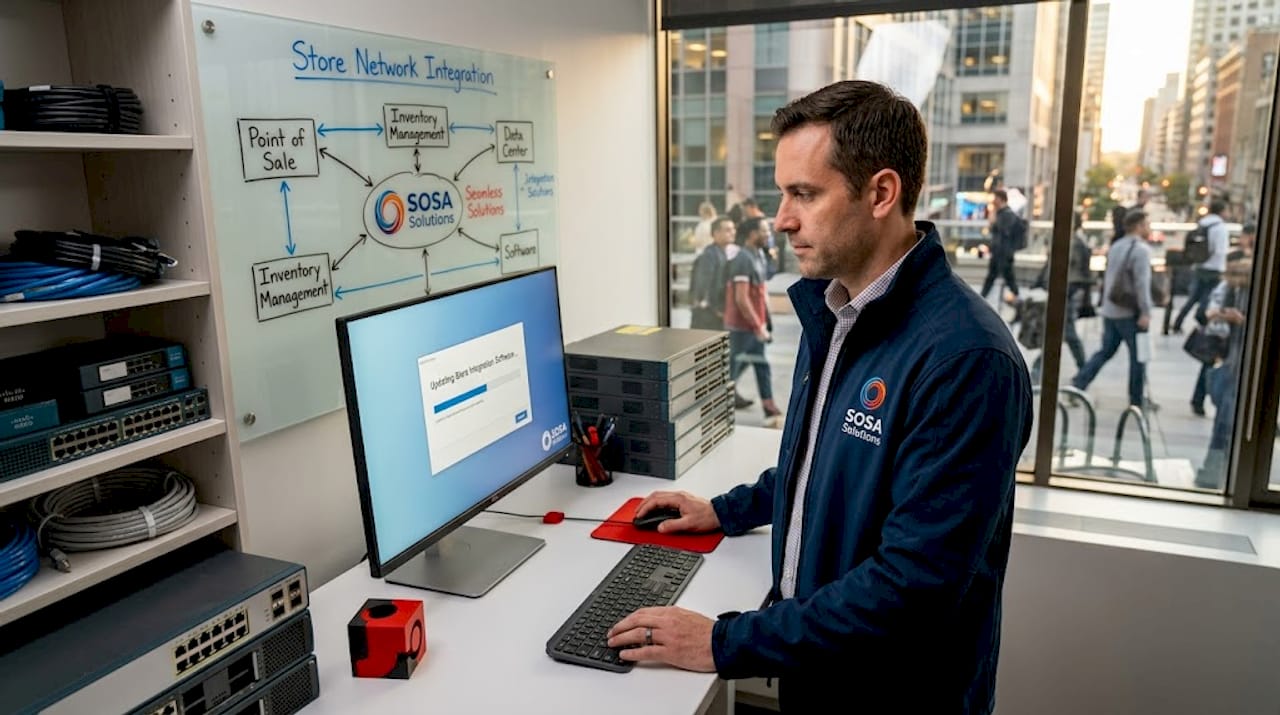
The solution isn’t just buying better software. It’s about how those systems are connected. Retail systems must connect POS, inventory, loyalty, ecommerce, and other tools, which means retailers increasingly need partners who can implement integration patterns rather than isolated deployments.
Disconnected systems | Connected, integrated systems |
Manual data entry across platforms | Automated data sync in real time |
Inventory errors and stock discrepancies | Accurate, live inventory across all locations |
Loyalty points that don’t reflect all purchases | Unified customer profiles across channels |
Delayed or inaccurate business reports | Real-time dashboards with reliable data |
High staff workload for routine tasks | Streamlined workflows with fewer manual steps |
Longer troubleshooting when issues arise | Centralized monitoring for faster resolution |
The table above tells a clear story. Disconnected systems don’t just create technical headaches. They create business problems: slower staff, unhappy customers, and decisions made on bad data. An IT partner who specializes in retail integration can map your entire technology stack, identify where the gaps are, and build the bridges that make everything work together.
Pro Tip: Before signing up for any new retail software, ask your IT partner whether it offers API-based integration with your existing systems. An API-first approach is the gold standard for keeping all your tools connected without constant manual workarounds.
The right managed IT services provider doesn’t just manage your hardware and network. They understand how your business systems need to communicate, and they build and maintain those connections so your team can focus on serving customers instead of fighting technology.
Proactive IT partnerships: Beyond break/fix to strategic enablement
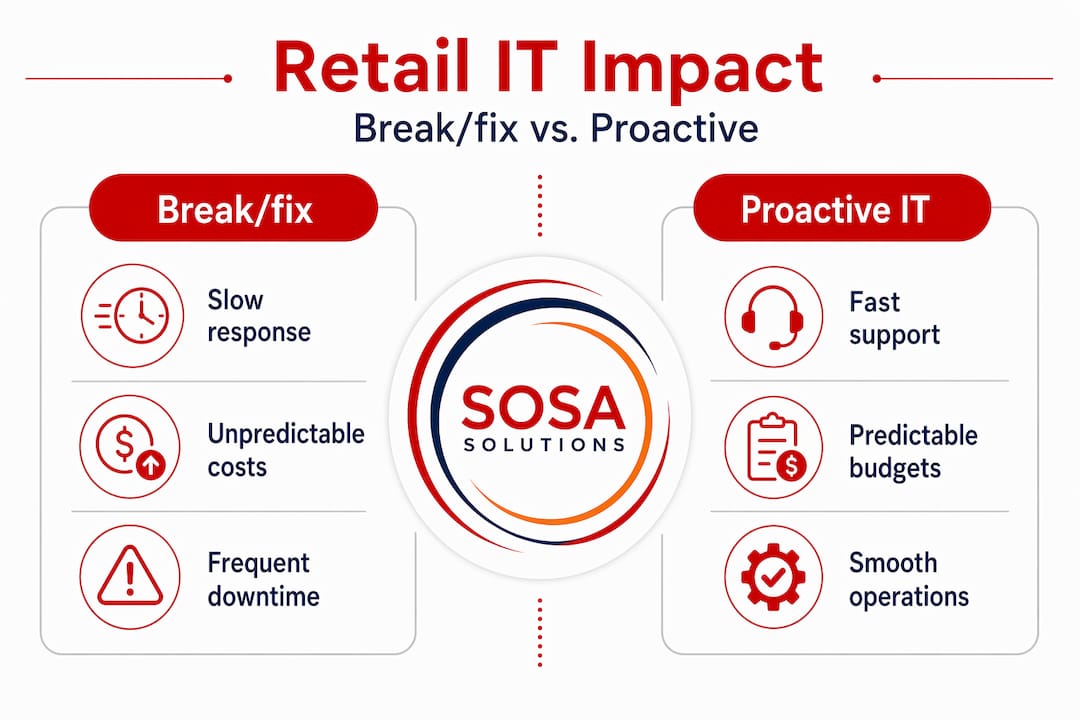
Most small and mid-sized retailers have experienced the traditional break/fix model at some point. Something breaks, you call someone, they fix it, and you wait for the next problem. It’s reactive, unpredictable, and expensive in ways that aren’t always obvious. Every hour your store operates with a known issue, you’re absorbing risk. Every time an IT problem catches you off guard, you’re paying emergency rates and losing revenue at the same time.
Proactive IT partnerships work completely differently. Instead of waiting for failures, your IT partner monitors your systems continuously, identifies warning signs before they become outages, and resolves issues before your staff or customers even notice them.
Here’s what a proactive IT partnership typically delivers, in order of business impact:
Continuous system monitoring that catches hardware failures, network instability, and software errors before they escalate
Scheduled maintenance and updates that keep systems secure and running at peak performance
Documented incident response plans so your team knows exactly what to do when something does go wrong
Regular reporting on system health, uptime percentages, and resolved incidents
Technology roadmap planning so your IT infrastructure grows alongside your business
The difference in outcomes is significant. Proactive monitoring and faster incident resolution keep multi-store operations running with predictable reliability, which is something no break/fix arrangement can promise.
Support model | Average response time | Cost predictability | Business impact |
Break/fix (reactive) | Hours to days | Unpredictable, high emergency costs | High risk of extended downtime |
Managed IT (proactive) | Minutes to hours | Fixed monthly cost | Minimal downtime, strategic planning |
For retailers planning to open new locations, this distinction matters even more. A new store launch involves dozens of interconnected IT tasks: network setup, POS installation, system configuration, staff training, and integration testing. Getting expert store opening IT solutions from the start means your new location opens on schedule, fully operational, with every system talking to every other system from day one.
Leveraging AI and automation: The future-proof advantage
Retail technology is moving fast, and the businesses that adapt early are building advantages that are genuinely hard to close. Artificial intelligence and automation are no longer tools reserved for enterprise-level chains. They’re becoming practical, accessible, and increasingly necessary for any retailer who wants to stay competitive in markets as demanding as New York and Florida.
AI and digital-automation approaches are being applied to retail operations and can reduce downtime and improve execution consistency, making it more important that IT partners can operate and support advanced tooling, not just traditional break/fix support.
What does this look like in practice? Here are some of the most impactful applications:
AI-powered monitoring tools that learn your systems’ normal behavior and flag anomalies before they cause problems
Automated patch management that keeps software updated without requiring manual intervention or scheduled downtime
Predictive inventory alerts that use sales data to flag potential stockouts before they happen
Automated network diagnostics that identify connectivity issues and reroute traffic without waiting for a technician
Digital reporting tools that generate accurate business intelligence from your connected systems in real time
The consistency benefit is often underestimated. Human-driven IT support, no matter how skilled, introduces variability. Technicians get sick, miss alerts, or make judgment calls that don’t always pan out. AI-assisted monitoring runs 24 hours a day, seven days a week, with the same level of attention at 3 a.m. on a Sunday as it applies at noon on a Tuesday.
Pro Tip: When evaluating IT partners, ask specifically about their automation and AI monitoring capabilities. A partner who relies entirely on manual monitoring is already behind the curve. Look for providers who use intelligent alerting tools that reduce response times and catch issues before they affect your customers.
Choosing AI-ready retail IT partners isn’t just about keeping up with trends. It’s about building a technology foundation that stays ahead of problems, scales with your business, and frees your team to focus on what they do best: selling, serving customers, and growing your brand.
The uncomfortable truth: Most retailers hire IT too late (and pay the price)
After working closely with retail businesses across New York and Florida, we’ve seen the same pattern repeat itself more times than we can count. A retailer opens their first location with minimal IT planning. Things work well enough, so IT stays an afterthought. Then they open a second store, add an ecommerce channel, launch a loyalty program, and suddenly the whole operation is held together with workarounds and manual processes. By the time they call us, they’re already dealing with daily frustrations, and the cost to untangle years of patchwork decisions is significantly higher than it would have been to do it right from the start.
The conventional wisdom in retail is to focus spending on inventory, marketing, and staff. IT is often treated as an overhead cost to minimize. This thinking is exactly backwards. Every dollar invested in solid IT infrastructure before a problem occurs saves three to five dollars in emergency fixes, lost revenue, and operational disruption after the fact. That’s not a guess. It’s what we see consistently.
The retailers who thrive, the ones who open new locations smoothly, scale their ecommerce alongside their physical stores, and recover from technical incidents without drama, are the ones who engaged early IT support for retailers as a strategic partner before they needed one. They planned their infrastructure, built their integrations correctly the first time, and established monitoring and response protocols that kept their operations stable through every phase of growth.
There’s also a competitive reality here that’s easy to overlook. Your competitors in New York and Florida are investing in IT. The ones who are growing fastest aren’t doing it by accident. They have systems that work, data they can trust, and IT partners who help them move faster than businesses still fighting technology fires every week. Viewing IT as an investment rather than a cost isn’t just good practice. It’s the mindset that separates retailers who grow from those who stall.
Ready to transform your retail operations with the right IT partner?
If anything in this article resonated with you, whether it’s the frustration of disconnected systems, the anxiety of a new store launch, or the nagging sense that your IT setup isn’t keeping pace with your ambitions, the right next step is a conversation with a team that understands retail from the inside out.
At Sosa Solutions, we work specifically with retail businesses in New York and Florida to build IT environments that are reliable, integrated, and ready to scale. Whether you need ongoing retail IT support NY & FL, a fully managed infrastructure through our managed IT services NY & FL, or expert guidance for a new location through our store opening IT solutions NY & FL, we bring the regional knowledge and hands-on experience your business deserves. Let’s build something that works.
Frequently asked questions
What does an IT partner do for retailers?
An IT partner provides proactive monitoring, unified system management, quick incident response, and technology integration to maximize uptime and operational efficiency across all store locations.
Why are connected retail systems important?
Connected systems cut errors and improve business insights by ensuring POS, inventory, and ecommerce data flow seamlessly together, reducing manual work and giving you reliable, real-time information.
How does AI improve retail IT operations?
AI automates monitoring and troubleshooting, reduces manual workload, and improves uptime consistency, making retail operations more predictable and easier to scale.
Should I hire an IT partner before opening a new store?
Yes, involving an IT partner early in the store planning phase helps avoid costly delays and ensures all systems are properly integrated and fully reliable from the moment you open your doors.
Recommended


Comments