Why Managed Services Beat Break-Fix for Retail IT

Most retail business owners assume break-fix IT support saves money. Pay only when something breaks. No monthly fees. Simple math. Except the math is wrong. The real reason why managed services beat break-fix comes down to what break-fix never accounts for: the hours your POS system is down during peak traffic, the security breach that wiped customer data, and the tech vendor who doesn’t show up until Tuesday. Retail IT has zero tolerance for that kind of uncertainty. This guide breaks down exactly what each model costs you, where managed services win on every metric that matters, and how to know when it’s time to make the switch.
Table of Contents
Key Takeaways
Point | Details |
Break-fix hides real costs | Downtime losses and emergency rates far exceed what a predictable monthly fee would cost. |
Managed services prevent, not just fix | Proactive monitoring catches issues before they disrupt your store operations or customers. |
Security gaps kill retailers | Managed services include ongoing patching and threat prevention; break-fix leaves you exposed between incidents. |
Scaling gets harder with break-fix | As your retail footprint grows, reactive IT support creates bottlenecks that slow down operations. |
Transition requires a plan | Moving to managed services works best with a phased approach starting from a baseline IT assessment. |
Why managed services beat break-fix: the core difference
Before comparing outcomes, you need a clear picture of what each model actually is. These are not just different pricing structures. They represent fundamentally different philosophies about IT.
Break-fix is exactly what it sounds like. Your equipment fails, you call a technician, you pay for the visit and the fix, and you move on. No ongoing relationship. No monitoring. No planning. Break-fix IT support waits for failure before taking any action, which means every problem reaches full impact before anyone addresses it. In a retail environment, that could mean a register going down during a Saturday rush, or a network outage killing contactless payments for an entire afternoon.
Managed services operate on a subscription model where a provider takes ongoing responsibility for your IT environment. You get a defined set of services, response time guarantees through service level agreements, and a team that monitors your systems around the clock.
Here is what managed services typically cover in a retail context:
24/7 infrastructure monitoring and alerting
Scheduled maintenance and software patching
Network management and performance optimization
Cybersecurity threat detection and response
Help desk access for staff issues
Strategic IT planning and technology roadmaps
Pro Tip: When evaluating a managed services provider, ask specifically what their average response time is for POS-related incidents. A generic SLA means little if retail-critical systems aren’t prioritized.
The difference in retail is stark. A managed services provider knows your environment before anything goes wrong. A break-fix technician often walks in blind.
Managed services vs break-fix: what the numbers actually show
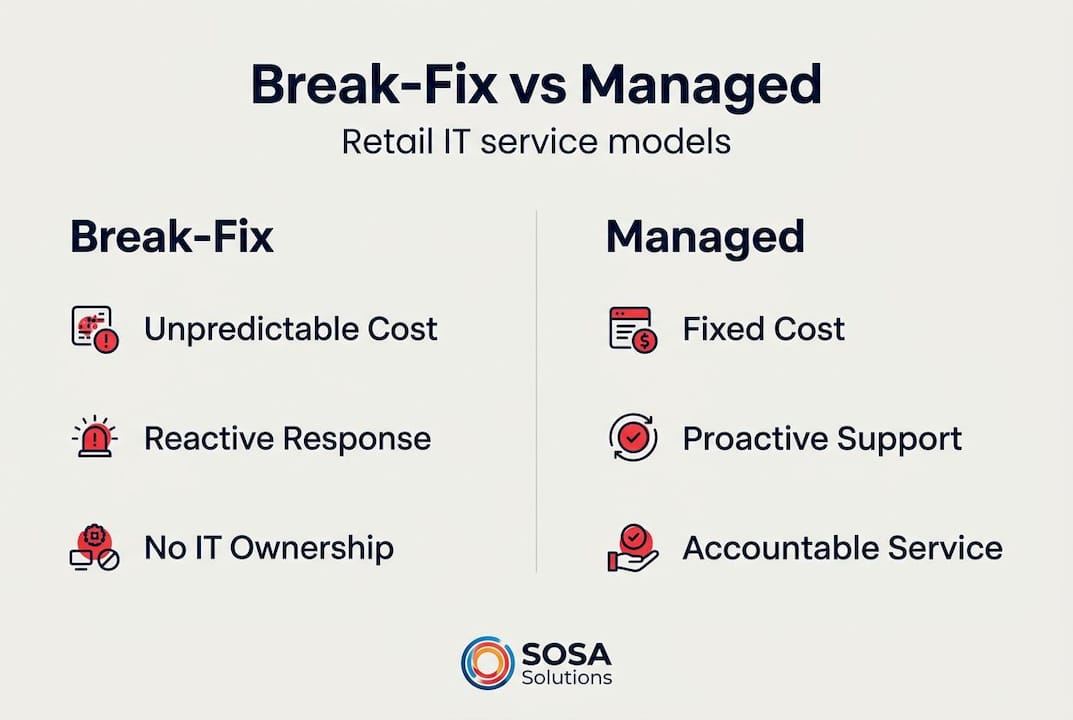
The cost of break-fix services looks low on paper. A one-time repair fee feels more controlled than a monthly commitment. But the true cost of IT downtime consistently exceeds the repair bill itself, especially in retail where every hour offline translates directly to lost sales.
Factor | Break-Fix | Managed Services |
Monthly cost | Variable, unpredictable | Fixed, predictable |
Response time | Hours to days | Minutes to hours (per SLA) |
Security coverage | Reactive only | Continuous monitoring |
Downtime frequency | Higher (no prevention) | Lower (proactive maintenance) |
Strategic planning | None | Included |
Staff IT burden | High | Low |
Break-fix creates budget instability. Emergency callout rates are higher than standard rates. If a failure happens on a holiday weekend, that multiplies further. Retail businesses that rely on break-fix often absorb these costs reactively, never fully calculating the cumulative annual spend until it’s compared to what a managed services contract would have cost.
Security is where the gap becomes genuinely alarming. Managed services include proactive patching, vulnerability scanning, and threat prevention built into the monthly agreement. Break-fix addresses security only after a breach or failure has already occurred. For retail businesses handling payment card data, that reactive posture creates serious compliance exposure.
Accountability also shifts dramatically. With break-fix, there is no single owner of your IT health. Vendors come and go. With managed services, you have a provider whose contract depends on keeping your systems running. That accountability changes behavior. They patch before problems appear, not after.
Pro Tip: Track your break-fix spending for 12 months, including lost revenue estimates during downtime events. Most retail operators are shocked by how that number compares to managed services pricing.
Managed services now account for 25 to 30 percent of the IT services market globally, with over 341,000 channel partners worldwide as of 2025. That scale reflects not just a trend but a proven business case across thousands of organizations.
How managed IT unlocks retail growth and technology adoption
The advantages of proactive support extend well beyond fixing what’s broken. This is where the conversation shifts from operational maintenance to strategic value, and it’s where managed services create distance that break-fix simply cannot close.
“Retail IT complexity grows faster than most internal teams can manage; managed services enable scaling without proportional increases in IT staff.” — TechBullion
Retail businesses opening new locations, adding e-commerce channels, or integrating loyalty programs face a sharp increase in IT complexity. Each addition brings new devices, new software, new network requirements, and new failure points. An internal IT team of one or two people simply cannot keep pace with that growth curve. Managed services help retailers overcome exactly that staffing bottleneck, giving you enterprise-grade coverage without hiring a full department.
AI integration is becoming a real operational tool in retail, from demand forecasting to customer behavior analytics. But deploying AI requires clean data pipelines, secure infrastructure, and technical expertise most retail IT teams don’t have in-house. Managed services enable faster AI adoption by removing the talent and infrastructure barriers that slow down technology implementation.
Here is what this looks like in practice for retail businesses:
A mid-size apparel retailer with five locations uses managed IT to maintain unified network performance across all stores without an internal IT manager at each site.
A specialty food retailer rolling out self-checkout kiosks relies on their managed services provider to monitor kiosk uptime and push software updates overnight.
A boutique chain expanding from New York to Florida uses unified IT service management to maintain consistency across geographically separated locations.
The productivity gains are real. When staff stop troubleshooting their own login issues and start spending that time serving customers, the business impact shows up in both satisfaction scores and revenue.
According to the KPMG Managed Services Outlook Survey 2026, the top investment areas for managed services in 2026 are AI management, cybersecurity, and compliance. Those are not IT concerns. They are business survival concerns for retail operators.
Signs your retail business has outgrown break-fix
Recognizing the inflection point matters. Some retail businesses stay on break-fix longer than they should because the pain is intermittent, not constant. Here are the signs that the model has stopped working for you.
Your POS or network goes down more than once per quarter. Occasional failures are normal. Recurring ones signal that your infrastructure needs proactive attention, not repeated emergency fixes.
You’re running hardware or software past its support lifecycle. Aging infrastructure and growing security concerns are among the clearest warning signs for break-fix businesses. Unsupported systems are unpatched systems, and unpatched systems get compromised.
Your staff is doing informal IT work. When employees restart routers, reboot registers, or troubleshoot their own devices, your business is absorbing hidden IT labor costs that show up nowhere on a break-fix invoice.
You’ve had a security incident or near-miss. One breach is a signal. Two is a pattern. Break-fix offers no prevention layer, only cleanup.
You’re planning to grow. Opening a second location, adding a new sales channel, or upgrading your payment infrastructure requires IT planning. Break-fix providers don’t plan. They respond.
Pro Tip: Calculate the hourly revenue your store generates during peak hours, then multiply that by the total hours of IT-related downtime over the past year. That number usually makes the case for managed services faster than any brochure.
How to transition from break-fix to managed services
The shift from reactive to proactive IT doesn’t have to be disruptive. With the right approach, you can move your retail operation onto a managed services model without operational interruption.
Audit your current IT environment. Document every device, application, and network component you rely on. Transitioning to managed services works best when you start with a clear baseline inventory of what you have and what is underperforming.
Identify your highest-risk systems. Your POS infrastructure, payment processing systems, and internet connectivity carry the most operational weight. Prioritize these for immediate managed services coverage.
Select a provider with retail-specific experience. Generic IT support and retail IT support are not the same thing. A provider who understands POS architecture, retail peak seasons, and store opening logistics will serve you far better than a generalist.
Plan for a phased rollout. You don’t need to hand everything over on day one. Start with monitoring and helpdesk services, then layer in security management, hardware maintenance, and strategic planning over 60 to 90 days.
Communicate the change to your staff. Employees need to know who to call, how to submit a ticket, and what response times to expect. A managed services transition that skips internal communication creates confusion and erodes trust in the new system.
Pro Tip: Ask your shortlisted providers for references from retail clients specifically. A managed services provider who has supported store openings or multi-location retail operations will understand your environment without a steep learning curve.
My take: why reactive IT is a silent revenue killer
I’ve watched retail businesses hold onto break-fix support long after the evidence said they should move on. The reasoning is always the same: “We only call IT when something breaks, so we’re not paying for anything we don’t use.” That logic sounds reasonable until you account for what you’re not measuring.
In my experience, the most expensive IT problems in retail are not the ones that generate a service ticket. They’re the ones that quietly degrade performance for weeks before a visible failure occurs. Slow POS response times that frustrate checkout staff. Intermittent WiFi that makes inventory scanning unreliable. Security gaps that go unnoticed until a card breach surfaces months later. None of those generate a break-fix invoice until they become catastrophic.
What I’ve seen managed services do for retail businesses is change the entire relationship between technology and operations. Instead of technology being a background anxiety, it becomes a stable foundation. Staff stop worrying about whether the system will work and start focusing on the customer in front of them.
The cost-effectiveness argument for break-fix also tends to fall apart at scale. A single-location boutique might survive on reactive support. A five-location retailer with integrated e-commerce, loyalty programs, and real-time inventory cannot. The complexity outpaces the model.
My honest advice: if you’re running more than two locations or processing significant card volume, you’ve already outgrown break-fix. The monthly managed services fee isn’t an expense. It’s the price of not losing revenue to downtime.
— Christopher
How Sosasolutionsnyc supports retail IT across NY and FL
Sosasolutionsnyc works specifically with retail businesses in New York and Florida that need IT support built around how retail actually operates, not how a generic IT provider thinks it does.

Their managed IT services cover proactive monitoring, security management, help desk access, and strategic planning under a predictable monthly agreement. For retailers opening new locations, Sosasolutionsnyc provides store opening IT solutions covering infrastructure setup, POS configuration, and network readiness from day one. Their retail IT support team handles both on-site and remote issues with response times designed for retail-critical environments. If you’re ready to stop absorbing the hidden costs of break-fix and move to a model built around preventing problems instead of chasing them, reach out to Sosasolutionsnyc for an assessment.
FAQ
What is the main difference between managed services and break-fix?
Break-fix IT support is reactive, meaning you pay for repairs only when something fails. Managed services are proactive, providing continuous monitoring, maintenance, and support under a fixed monthly agreement with defined response times.
Why does break-fix cost more in the long run?
The cost of break-fix services extends beyond repair fees to include lost revenue during downtime, emergency callout premiums, and unaddressed security vulnerabilities. Downtime costs typically exceed the repair bill itself for retail businesses.
How do managed services improve efficiency in retail operations?
Managed services reduce system downtime, free staff from informal IT troubleshooting, and provide faster resolution through proactive monitoring. This directly improves how managed services improve efficiency across checkout, inventory, and customer-facing operations.
When should a retail business switch from break-fix to managed services?
You should consider switching when you experience recurring outages, aging infrastructure, growing security concerns, or plans to expand locations. Frequent outages and security issues are the clearest indicators that break-fix has stopped serving your business effectively.
Can managed services support retail businesses during new store openings?
Yes. Managed services providers with retail experience handle infrastructure setup, network configuration, and POS readiness as part of store launch support, reducing the risk of technical failures during a critical opening period.
Recommended


Comments