The Role of IT Vendor Management in Business Growth
- Sosa Solutions NYC
- Jul 4
- 8 min read

IT vendor management is defined as the strategic discipline of overseeing the full lifecycle of relationships with technology suppliers to maximize business value and reduce operational risk. Most organizations treat it as a procurement function. The ones that treat it as a governance discipline consistently outperform. Mature Vendor Management Offices achieve 15–20% greater value from vendor contracts than teams managing vendors on an ad hoc basis. That gap compounds over time. Sosasolutionsnyc works with retail businesses and SMBs across New York and Florida that feel this gap directly, often without knowing what is causing it.
What is the role of IT vendor management in business operations?
IT vendor management, formally known as Vendor Lifecycle Management (VLM) in PMI and CIOPages frameworks, governs every interaction with a technology supplier from initial selection through final offboarding. The role is not just administrative. It is the function that decides whether your technology investments deliver what was promised or quietly drain budget and productivity.

Effective IT vendor management follows a lifecycle of six stages: selection, onboarding, governance, performance monitoring, risk and compliance, and offboarding. Each stage carries distinct responsibilities. Skipping or rushing any one of them creates gaps that vendors rarely volunteer to fill.
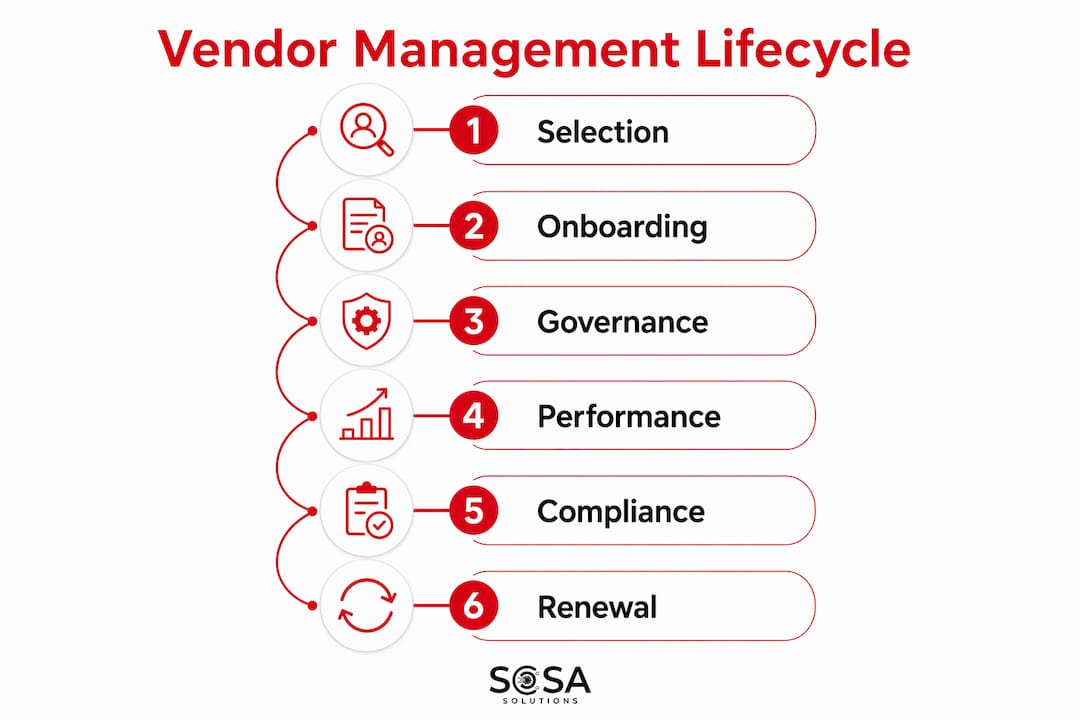
The importance of vendor management becomes clearest when something goes wrong. A missed SLA, a security breach traced to a third-party tool, or a contract auto-renewal at a higher rate. All of these are vendor management failures, not vendor failures. The client organization holds ultimate accountability for outcomes.
What key roles and responsibilities make up IT vendor management?
Vendor management is not a single job. It is a set of coordinated responsibilities distributed across procurement, IT leadership, legal, and operations. Understanding who owns what prevents the most common failure mode: unowned work.
The six core responsibilities break down as follows:
Vendor selection and due diligence. This covers evaluating suppliers against technical, financial, and security criteria before any contract is signed. A structured scoring rubric prevents selection based on familiarity or price alone.
Contract negotiation and renewal management. Contracts define the rules of the IT supplier relationship. Negotiating SLAs, exit clauses, and pricing tiers at the start protects the organization from costly surprises at renewal.
Onboarding and integration. Getting a vendor operational inside your environment requires documented processes, access controls, and clear timelines. Poor onboarding delays value realization by weeks or months.
Performance monitoring and KPI tracking. This is where most organizations fall short. Tracking vendor performance against agreed metrics requires a regular cadence, not just annual reviews.
Risk and compliance oversight. Every vendor with access to your systems or data is a potential liability. Ongoing compliance checks, security audits, and contractual risk clauses are non-negotiable.
Offboarding and transition management. Ending a vendor relationship cleanly, including data retrieval, access revocation, and knowledge transfer, prevents operational disruption and legal exposure.
Pro Tip: Assign a named internal owner to each vendor relationship. Even a single point of contact prevents the “someone else is handling it” assumption that lets performance issues go unaddressed for months.
Executive engagement is not optional at the governance level. Senior leadership involvement unlocks access to better vendor resources, faster escalation paths, and problem resolution that delivery teams cannot reach on their own.
How does IT vendor management reduce hidden costs and improve efficiency?
The hidden cost of poor vendor management is not in any single invoice. It accumulates in coordination overhead, missed renewals, duplicated tools, and unresolved performance issues that nobody owns.
Businesses managing five or more IT vendors often spend over 10 hours per month on coordination overhead alone. That is time pulled from IT staff who should be focused on delivery, not vendor wrangling. Multiply that across a year and the cost is substantial, even before accounting for the downstream effects on project timelines.
Vendor sprawl is the specific risk that grows with every new supplier added without a formal management structure. Consider what sprawl looks like in practice:
Duplicate tools. Two vendors providing overlapping capabilities, each billing separately, with no internal owner comparing value.
Untracked renewals. Contracts auto-renewing at rates negotiated three years ago, often with terms that no longer reflect current usage.
Fragmented support. Multiple vendors each pointing at the others when an issue crosses system boundaries, leaving internal teams to mediate.
Compliance blind spots. Security and data handling requirements that apply to one vendor but were never extended to others added later.
After five vendors, the internal management overhead typically warrants formal coordination or outsourced management. This is not a scale problem unique to large enterprises. Retail businesses with five to ten technology suppliers, including POS systems, networking, cybersecurity, and cloud services, hit this threshold regularly.
Formal vendor management eliminates these costs systematically. Centralized contract tracking, standardized performance reviews, and a single coordination function reduce the overhead that sprawl creates. For retail operators, centralized IT management across multiple vendors is the difference between a predictable technology budget and a reactive one.
What best practices and strategies ensure successful IT vendor management?
The organizations that get the most from their IT supplier relationships share a common trait: they treat vendor management as a discipline with defined processes, not a task that gets handled when problems arise.
Segment vendors by strategic importance
Segmenting vendors by impact and spend into Strategic, Tactical, Commodity, and Innovation categories focuses management effort where risk and opportunity are greatest. A cloud infrastructure provider that runs your core systems deserves executive-level attention and quarterly business reviews. A commodity supplier providing office peripherals does not.
This two-axis approach, mapping spend against business impact, prevents the common mistake of applying the same management intensity to every vendor. It also makes resource allocation decisions defensible.
Build a cross-functional governance structure
A cross-functional Vendor Governance Board that includes procurement, security, engineering, and legal improves decision quality and oversight. Each function brings a different risk lens. Security flags access and data concerns. Legal flags contract exposure. Engineering flags technical fit. Procurement flags cost and terms.
No single function sees the full picture. The board structure forces deliberate trade-offs instead of siloed decisions.
Separate integrator accountability from vendor delivery
Governance cannot be fully delegated to vendors. The client organization must maintain an internal integrator role, accountable only to the business, that sits above vendor delivery teams. This role coordinates across suppliers, resolves cross-vendor conflicts, and holds the overall outcome accountable. Without it, vendors optimize for their own scope, not for the business result.
Use a Vendor Management System (VMS)
A VMS centralizes contract data, renewal dates, performance metrics, and vendor contacts in one place. It replaces spreadsheets and email threads with a single source of truth. For organizations managing more than three or four vendors, a VMS is not a luxury. It is the infrastructure that makes everything else work.
Pro Tip: Set automated renewal alerts at 90, 60, and 30 days before contract expiration. Most unfavorable auto-renewals happen because the internal team missed the window to renegotiate.
For retail businesses, IT support contracts that clearly define vendor responsibilities and performance benchmarks are the foundation of this entire structure.
How can businesses manage multi-vendor IT projects without delays?
Multi-vendor IT projects fail most often not because of technical complexity, but because of unclear ownership. When two vendors share a boundary, the space between them becomes unowned work. Unowned work becomes delays, cost overruns, and finger-pointing.
Defining clear scope boundaries between vendor responsibilities prevents unowned tasks and the budget creep that follows. This requires more than a contract. It requires a detailed responsibility matrix that names which vendor owns which deliverable, what the handoff criteria are, and who resolves disputes.
A structured approach to multi-vendor project management includes these steps:
Create an integrated project plan. Require each vendor to submit their workplan in a common format. Merge them into a single master schedule that shows dependencies across vendors.
Define handoff criteria explicitly. Specify what “done” means at each vendor boundary. Ambiguous handoffs are where projects stall.
Establish a single communication protocol. All cross-vendor issues escalate through one internal coordinator, not directly between vendor teams. This prevents informal agreements that bypass governance.
Apply PMI PMP V7 principles for outcome-based accountability. PMI’s V7 framework shifts focus from process compliance to business outcomes. Each vendor is measured against the outcome their work enables, not just task completion.
Run weekly cross-vendor status reviews. Bring all vendors into a shared forum weekly. Issues that affect multiple parties surface faster and get resolved before they cascade.
Senior leadership engagement at critical project milestones signals organizational priority to vendor teams and accelerates resource allocation when timelines are at risk. Vendors respond differently when they know the client’s leadership is paying attention.
Key Takeaways
Effective IT vendor management is the single most controllable factor in whether your technology investments deliver their promised value or quietly erode it.
Point | Details |
Formal VMOs outperform ad hoc management | Mature Vendor Management Offices capture 15–20% more contract value than unstructured approaches. |
Vendor sprawl creates measurable overhead | Managing five or more vendors without structure costs over 10 hours per month in coordination time. |
Segmentation focuses effort correctly | Categorizing vendors as Strategic, Tactical, or Commodity prevents over-managing low-risk suppliers. |
Governance accountability stays internal | The client must retain an integrator role; delegating governance entirely to vendors creates blind spots. |
Scope clarity prevents project delays | Explicit responsibility boundaries between vendors eliminate unowned work and budget creep. |
Why most IT vendor programs fail at the governance layer
The most common mistake I see is organizations that build a solid vendor selection process and then assume the work is done. Selection is maybe 20% of the job. The other 80% is what happens after the contract is signed.
The “top-to-top” executive engagement principle is the one most organizations skip. They assign a junior IT manager to own the vendor relationship and wonder why they can never get the vendor’s A-team on their account. Vendors allocate their best resources to the clients whose leadership shows up. That is not cynical. It is how professional services firms operate.
Vendor segmentation is the second thing most programs get wrong. Treating a mission-critical infrastructure vendor the same way you treat a commodity hardware supplier wastes governance capacity on low-risk relationships while under-investing in the ones that can actually hurt you. The two-axis model, spend versus business impact, takes about two hours to build and changes how every subsequent decision gets made.
The hidden overhead of vendor sprawl is the issue that catches retail businesses off guard most often. A business that opens a second or third location adds vendors for each one, often without realizing the coordination burden is compounding. By the time the internal team is spending half their week on vendor calls, the damage is already done. Building the governance structure before you hit five vendors is far cheaper than rebuilding it after.
— Christopher
How Sosasolutionsnyc supports your IT vendor coordination
Managing multiple IT vendors across retail locations in New York or Florida is a full-time coordination challenge. Sosasolutionsnyc works directly with retail businesses and SMBs to take that coordination burden off internal teams, providing a single point of accountability across all technology suppliers.

Whether you are opening a new store and need every vendor aligned before launch day, or you are managing an existing multi-vendor environment that has grown beyond your team’s capacity, Sosasolutionsnyc brings the structure and experience to make it work. Their managed IT services cover vendor coordination, performance oversight, and ongoing support across New York and Florida. For retail operators planning a new location, their store opening IT solutions handle the full vendor setup from day one.
FAQ
What is IT vendor management?
IT vendor management is the structured process of selecting, contracting, monitoring, and governing technology suppliers across their full relationship lifecycle. Its purpose is to maximize the business value of vendor investments while controlling cost and risk.
Why does vendor management matter for small businesses?
Small businesses managing five or more IT vendors face the same coordination overhead as larger enterprises, often without dedicated staff to handle it. Formal vendor management prevents hidden costs from accumulating through missed renewals, duplicate tools, and unresolved performance issues.
What roles are involved in IT vendor management?
Core roles include a vendor owner or relationship manager, a contract administrator, a performance analyst, and an executive sponsor. In smaller organizations, one person may cover multiple roles, but each responsibility must have a named owner.
How do you prevent delays in multi-vendor IT projects?
Defining explicit scope boundaries between vendors and maintaining a single internal coordinator for cross-vendor issues are the two most effective controls. An integrated project plan with shared milestones keeps all vendors aligned to the same timeline.
What is a Vendor Management Office (VMO)?
A VMO is a dedicated internal function that centralizes vendor governance, contract management, and performance oversight. Organizations with a formal VMO consistently extract more value from vendor contracts than those managing vendors informally.
Recommended
Comments