IT Strategy for Small Business: Your 2026 Growth Plan
- Sosa Solutions NYC
- Jun 10
- 9 min read

An IT strategy is a business-driven plan that aligns every technology decision with your company’s operational goals and growth targets. The role of IT strategy for small businesses goes far beyond fixing broken computers or setting up Wi-Fi. It determines how your technology investments reduce costs, protect revenue, and create the capacity to scale. Tools like Microsoft 365, cloud-based infrastructure, and CRM platforms only deliver real value when they are part of a coordinated plan tied to measurable outcomes. Without that plan, you are spending money on technology that does not move your business forward.
How does an IT strategy support small business growth and efficiency?
Viewing IT as a strategic lever rather than a support cost fundamentally changes business outcomes, including faster sales cycles and better client experience. That shift in thinking is where the real value of a small business technology plan begins.
The most direct benefit is cost control through proactive management. Downtime costs for SMBs can run hundreds to thousands of dollars per minute, and those costs increase with outage duration and regulatory exposure. A structured IT strategy replaces reactive firefighting with predictable, planned investment. You stop paying emergency rates for problems that a scheduled maintenance cycle would have prevented.

Scalability is the second major benefit. Cloud and SaaS models let you add users, storage, and computing power without buying new hardware every time your team grows. Integration and automation through connected CRM, email, and invoicing systems via open APIs deliver measurable efficiency gains. When your tools talk to each other, your team stops manually re-entering data between platforms, which is one of the most common time drains in small businesses.
Security belongs inside your IT strategy from day one, not as an add-on after everything else is running. Retrofitting security post-implementation costs significantly more than building it in from the start. Access controls, data protection policies, and incident response procedures should be defined in your initial planning phase, not after a breach forces the issue.
Key efficiency gains a coordinated IT plan delivers:
Reduced manual data entry through connected systems like QuickBooks, HubSpot, and Google Workspace
Faster onboarding for new staff when tools and access protocols are standardized
Lower support costs when your tech stack is documented and your team is trained on it
Improved uptime through scheduled maintenance windows and redundancy planning
Stronger security posture through layered access controls and regular patch management
Pro Tip: Before adding any new tool, ask one question: does this connect to what we already use? If the answer is no, the productivity gain will likely be offset by the integration cost and the extra training burden.
What are the practical steps to build an IT strategy for your small business?
A strong IT strategy treats your technology plan as a living document aligned with SMART business goals, not a one-time document filed and forgotten. The most practical way to build one is through a phased timeline that matches your current capacity and future ambitions.
The 3-tier timeline framework structures IT planning into three stages: immediate (0 to 6 months), growth (6 to 18 months), and long-term (18 months and beyond). This prevents you from buying enterprise-level infrastructure before your business needs it, which is one of the fastest ways to waste IT budget.
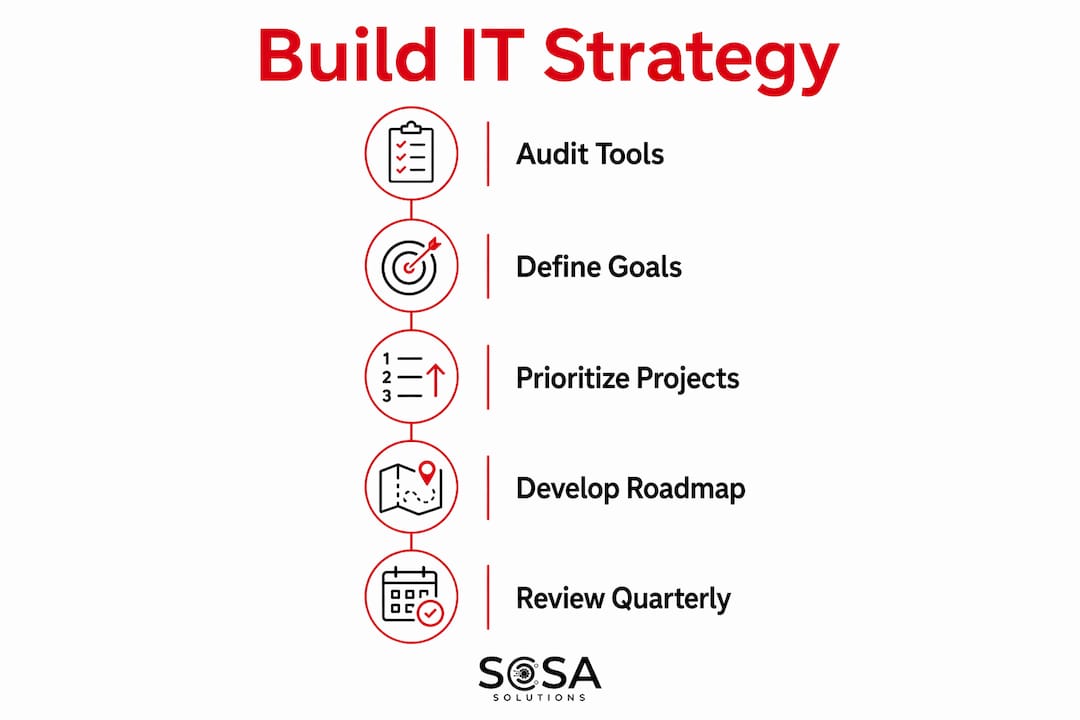
Here is how to build your plan step by step:
Audit your current tech stack. Auditing your existing tools often reveals redundant and incompatible software that should be eliminated before any new investment. List every tool, its monthly cost, who uses it, and whether it integrates with your other systems.
Define your business goals first. Your IT plan should answer specific business questions. Do you need to reduce customer response time? Speed up your invoicing cycle? Expand to a second location? Each goal maps to a technology decision.
Assign KPIs to every initiative. System uptime percentage, reduction in manual data entry hours, and time to onboard new tools are all measurable. If you cannot measure it, you cannot manage it.
Schedule infrastructure changes strategically. Aligning deployments to low-volume periods and running thorough testing before go-live prevents revenue loss from outages caused by poorly timed rollouts.
Decide on internal vs. external IT support. Most small businesses cannot justify a full-time IT director. Managed service providers fill that gap by providing strategic oversight, helpdesk support, and security monitoring at a fraction of the cost.
Schedule quarterly reviews. Your IT strategy is not finished when you write it. Set a calendar reminder every 90 days to review what is working, what is not, and what business priorities have shifted.
Planning phase | Timeline | Focus areas |
Immediate | 0 to 6 months | Audit tools, fix security gaps, standardize core platforms |
Growth | 6 to 18 months | Automate workflows, integrate systems, add cloud capacity |
Long-term | 18+ months | Scale infrastructure, explore advanced analytics, expand IT governance |
Pro Tip: Most small business owners think an IT roadmap has to be a 40-page document. The most effective ones are one or two pages, updated quarterly, and shared with every department head. Simplicity is what makes them actually get used.
Common pitfalls in small business IT strategy and how to avoid them
Small businesses without IT strategy frequently suffer from tool sprawl, which creates operational bottlenecks, security vulnerabilities, and higher costs. Recognizing these patterns early saves significant money and frustration.
The most common trap is “shiny object syndrome.” A new project management app launches, someone on your team recommends it, and suddenly you have three project management tools running simultaneously with no clear owner for any of them. Each uncoordinated purchase adds to your monthly spend, fragments your data, and creates training overhead. The fix is a simple governance rule: no new tool gets purchased without a documented business case and a designated owner.
The second major pitfall is treating IT as purely reactive support. When your only IT activity is responding to problems after they occur, you are always behind. Small businesses need IT strategy alignment more urgently than enterprises because they have less margin for costly inefficiencies. A single extended outage can damage customer relationships that took years to build.
Lack of governance is the third pitfall, and it is the one most business owners overlook. Governance means having clear policies around who can access what, how data is backed up, and what happens when a staff member leaves. Without it, you accumulate security risks that compound over time.
“An IT strategy that sits in a drawer is not a strategy. It is a document. The difference between the two is whether your team reviews it, updates it, and makes decisions based on it.”
Treating your IT plan as a static document is the fourth and most corrosive mistake. Technology changes, your business changes, and your strategy must reflect both. Build the review cadence into your calendar from day one, and assign someone accountability for keeping the plan current.
How to measure the impact of your IT strategy on business outcomes
Measurable KPIs tied to technology investments are the only reliable way to justify IT spending and identify what needs adjustment. Without measurement, you are guessing whether your technology is working.
Start by setting a baseline before any change is made. If your current average system uptime is 97%, your target might be 99.5% after implementing a new monitoring tool. If your team spends 10 hours per week on manual data entry, your target after CRM integration might be 3 hours. The baseline makes the improvement visible and defensible to stakeholders.
The most useful KPIs for small business IT strategy include:
System uptime percentage tracked monthly against a defined target
Mean time to resolve IT issues, which reflects the quality of your support structure
Reduction in manual data entry hours after automation or integration projects
Time to onboard new tools, which indicates how well your IT environment is documented
Security incident count tracked quarterly to measure the effectiveness of your controls
Customer response time as a downstream indicator of IT-enabled operational efficiency
Quarterly business reviews that track these metrics against your roadmap allow faster course corrections and provide clear ROI visibility. The cadence matters as much as the metrics. A review that happens once a year cannot catch problems before they become expensive. Quarterly reviews catch drift early, when corrections are still cheap.
Linking technology decisions to revenue-facing outcomes is what separates a strategic IT plan from a maintenance checklist. When you can show that a CRM integration reduced your sales cycle by two days, or that a new helpdesk tool cut customer complaint resolution time by 40%, IT stops being a cost center in every conversation you have with your leadership team or board.
Key takeaways
A small business IT strategy delivers measurable value only when it aligns technology investments with specific business goals, follows a phased timeline, and is reviewed and updated on a regular cadence.
Point | Details |
IT strategy is a business plan | Define technology decisions by business outcomes, not by available tools or vendor recommendations. |
Downtime has a direct cost | Proactive IT planning prevents outages that cost SMBs hundreds to thousands of dollars per minute. |
Use a 3-tier timeline | Structure your plan into immediate, growth, and long-term phases to avoid premature or oversized investments. |
Measure everything | Set baselines and KPIs for uptime, manual entry reduction, and response time before any initiative launches. |
Review quarterly | A strategy reviewed every 90 days catches misalignment early and keeps IT spending tied to real business priorities. |
Why I stopped calling IT a “support function” years ago
I have worked with dozens of small business owners who came to us after years of treating IT as something you call when something breaks. The pattern is always the same. They have four or five tools that do not talk to each other, a backup system nobody has tested in two years, and a vague sense that they are spending too much on technology without knowing why.
The mindset shift that changes everything is simple: your IT environment is either helping you grow or slowing you down. There is no neutral position. When I see a retail business in Manhattan running point-of-sale, inventory, and customer loyalty on three separate systems with no integration, I do not see a technology problem. I see a revenue problem that technology is causing.
The businesses that get the most from their IT investments are not the ones with the biggest budgets. They are the ones with the clearest connection between their technology decisions and their business goals. A two-person shop with a documented IT plan and quarterly reviews will outperform a ten-person shop running on instinct every time. The plan does not have to be complex. It has to be honest about where you are, specific about where you want to go, and reviewed often enough to stay relevant.
If you are reading this and realizing your current approach is mostly reactive, that is actually a good place to start. Knowing the gap is the first step toward closing it. Check out how IT drives retail growth to see what a proactive technology partnership looks like in practice.
— Christopher
How Sosasolutionsnyc helps small businesses execute their IT strategy
Small business owners in New York and Florida have a practical option for turning IT strategy from a concept into a working system. Sosasolutionsnyc provides managed IT services designed specifically for small and mid-sized businesses, covering everything from infrastructure planning and security monitoring to helpdesk support and cloud management.

Rather than hiring a full-time IT director, you get a dedicated team that understands your business goals, maintains your systems proactively, and responds fast when something goes wrong. Sosasolutionsnyc also specializes in store opening IT solutions for retail businesses launching new locations, handling system setup, network infrastructure, and day-one readiness so your opening goes smoothly. If you want technology that works for your business instead of against it, this is where to start.
FAQ
What is the role of IT strategy in a small business?
An IT strategy aligns every technology investment with your business goals, replacing reactive spending with a planned approach that reduces downtime, controls costs, and supports growth. It treats technology as a business driver, not just a support function.
How does IT strategy help small firms avoid costly mistakes?
Without a coordinated plan, small businesses accumulate redundant tools, security gaps, and unplanned outages that cost hundreds to thousands of dollars per incident. A documented strategy with governance rules and quarterly reviews prevents these patterns before they become expensive.
What KPIs should I track for my small business IT plan?
The most useful metrics are system uptime percentage, mean time to resolve IT issues, reduction in manual data entry hours, and customer response time. Set a baseline before any initiative launches so improvements are measurable and defensible.
How often should a small business update its IT strategy?
Quarterly reviews are the recommended cadence. This frequency catches misalignment early, keeps the plan tied to current business priorities, and allows course corrections before small problems become large ones.
Do small businesses really need a formal IT strategy?
Small businesses need IT strategy alignment more urgently than enterprises because they have less margin for inefficiency. Even a one-page plan with a 3-tier timeline and defined KPIs delivers significantly better outcomes than an ad-hoc approach.
Recommended
Comments