Switching Managed IT Providers: A 2026 Decision-Maker's Guide

Switching managed IT providers is a controlled operational process that requires structured governance, disciplined execution, and clear ownership to protect business continuity. The industry term for this process is a managed service transition, and when done correctly, it converts what feels like a high-risk vendor change into a predictable, documented handover. This guide covers every stage of that process, from pre-transition discovery through secure offboarding, using frameworks like ITIL, ISO 27001, and RACI matrices that experienced IT decision-makers rely on. Whether you are changing IT service providers for the first time or managing your third transition, the principles here apply directly to your situation.
What must you do before switching managed IT providers?
The single most dangerous mistake in any managed IT service transition is skipping thorough discovery. Four discovery outputs are non-negotiable before any cutover: a reconciled asset inventory, a map of critical business flows, an access map covering all admin and service accounts, and validated backups with confirmed restore capability. Each of these outputs becomes a working document that your incoming provider uses to take ownership without guessing.
Start with a full asset and access inventory. Document every device, server, cloud subscription, SaaS license, and network appliance your business uses. Then map which applications are critical to daily operations, such as your point-of-sale system, ERP, or communication platform, and identify the dependencies between them. This mapping prevents the scenario where a new provider fixes one system and unknowingly breaks another.

Backup validation is where most transitions quietly fail. Performing a restore test before the transition confirms that your data is actually recoverable, not just theoretically backed up. This step is separate from verifying that backups exist. A backup that has never been restored is an assumption, not a guarantee.
Governance setup is the final prerequisite layer. Assign a RACI matrix to every transition task so that each workstream has one accountable owner, not a committee. Negotiate exit cooperation terms with your outgoing MSP in writing, including their obligation to provide documentation, credential handover, and a cooperation window. Review your existing contract for termination clauses, data return obligations, and any notice periods before you sign anything with a new provider.
Prerequisite output | Governance role responsible |
Reconciled asset inventory | Project manager |
Critical business flow map | Service owner |
Access and credential map | Security representative |
Validated backup restore test | Operations lead |
Risk register and issue log | Project manager |
Pro Tip: Assign a dedicated transition sponsor at the executive level. This person has authority to resolve blockers quickly and prevents the project from stalling when the outgoing MSP delays documentation delivery.
How do you plan and execute the transition to minimize downtime?
A parallel run with explicit ticket boundaries is the single most effective mechanism for a low-risk cutover. During the parallel run period, both the outgoing and incoming providers are active, but ticket ownership is split by category. Routine requests go to the new provider. Escalations on legacy systems stay with the outgoing provider until the cutover date. This boundary prevents confusion and builds the new provider’s operational familiarity before they carry full responsibility.
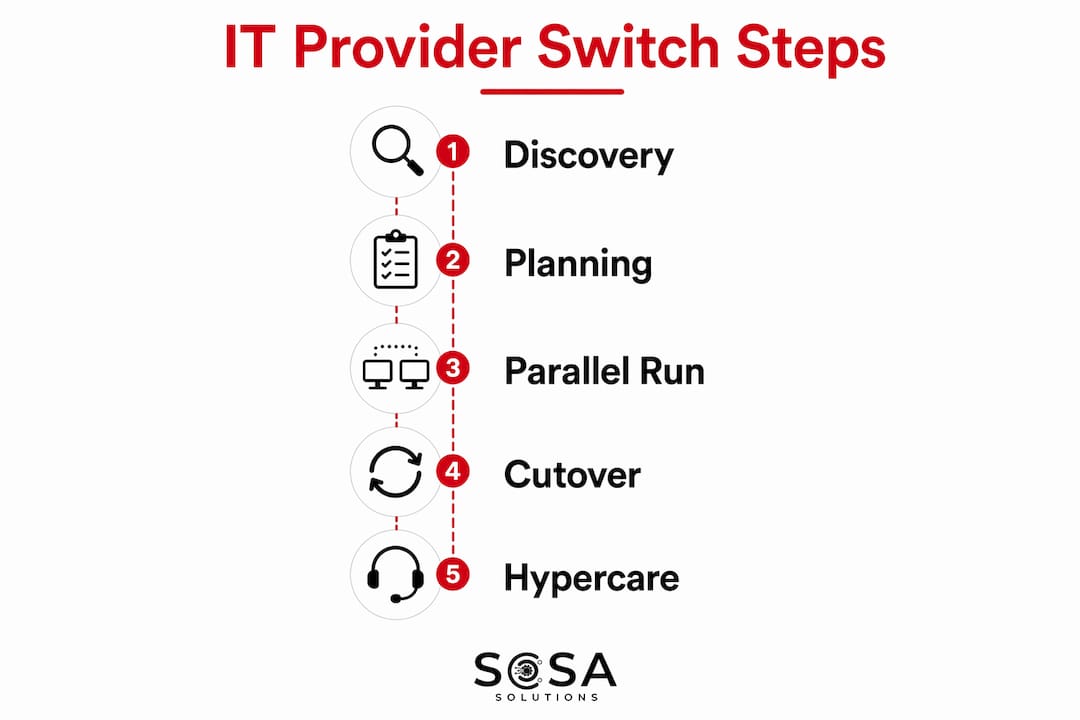
Before cutover day, implement a short change freeze on non-essential modifications. Cutover discipline, including freeze periods and sequencing, matters more than speed for maintaining service stability. Freezing changes 48 to 72 hours before cutover removes variables and gives your team a stable baseline to test against.
The cutover itself should follow a sequenced checklist, not improvised judgment calls. Here is a proven execution sequence:
Confirm all discovery outputs are current and signed off by both parties.
Complete credential rotation for all admin accounts and service accounts.
Validate that monitoring and alert routing point to the new provider’s systems.
Execute a final backup and confirm restore capability on the new infrastructure.
Redirect helpdesk contact points, email aliases, and ticketing system access to the new provider.
Confirm escalation paths with the new provider’s on-call team.
Conduct a go/no-go call with your sponsor, project manager, and service owner.
Execute cutover during a low-traffic window, typically a weekend or off-peak period.
Activate the rollback plan trigger criteria in writing before proceeding.
Run a post-cutover verification sweep within the first two hours.
Define rollback triggers before you start. A rollback is not a failure. It is a pre-planned response to a specific condition, such as a critical application being unreachable after 60 minutes of troubleshooting. Having that threshold written down removes the emotional pressure of deciding in the moment.
Pro Tip: Run a 15-minute daily stand-up during cutover week with your project manager, the new provider’s lead, and your operations contact. This cadence catches routing errors and access gaps before they become incidents.
What governance practices prevent support gaps after go-live?
Ownership and support routing must be explicitly accepted before go-live to prevent escalation delays and operational confusion. This is not a technical question. It is a capability question. Your new provider may have the technical skills to manage your environment, but if your staff does not know who to call for which issue, response times collapse and frustration builds fast.
The ITIL-aligned transition ownership breakdown pattern identifies five acceptance signals that confirm operational readiness. Your team should verify all five before declaring the transition complete:
Every IT component has a named owner on the new provider’s side with confirmed contact details.
Support routing is documented and tested, meaning a real ticket was submitted and resolved through the new system.
Escalation paths are understood by both the provider’s team and your internal staff.
Access approvals are active, with the new provider holding all credentials needed to perform their work.
Monitoring and alerting are confirmed live, with at least one test alert verified end-to-end.
Early life support, also called hypercare, is a structured period of heightened attention immediately after go-live. During hypercare, the new provider commits to faster response times, daily check-ins, and proactive monitoring. This period typically runs two to four weeks and serves as the buffer between cutover and normal operations. Handover failures mostly stem from unclear operational ownership during these early post-cutover days, and hypercare directly addresses that risk.
For retail businesses managing multiple locations, the role of IT in retail operations makes ownership clarity even more critical. A support gap at a single store location can affect transactions, inventory, and customer experience simultaneously.
How do you manage data security and offboarding from the old provider?
Secure data deletion during MSP offboarding is governed by ISO 27001 A.8.10 controls, which require documented sanitization of all client data held by the outgoing provider. The challenge is that multi-tenant backup environments make traditional overwriting impractical. In those cases, cryptographic erasure per NIST SP 800-88 is the accepted method. This means the encryption keys for your data are destroyed, rendering the data unreadable even if the physical storage persists.
Credential rotation is not optional after cutover. Every admin account, service account, API key, and shared password that the outgoing provider had access to must be rotated before you consider the transition complete. Post-transition verification includes confirmed restore tests, updated documentation, and full credential rotation as final steps. Skipping rotation leaves your environment exposed to access by a party that no longer has a contractual relationship with your business.
Role-based access control (RBAC) is the correct framework for provisioning the new provider’s access. RBAC with explicit access requests improves security and onboarding repeatability by requiring business justification and manager approval for each permission granted. Never copy permissions from a departed user or outgoing provider account. That pattern inherits undocumented access and creates audit risk.
Offboarding practice | Common pitfall to avoid |
Cryptographic erasure for multi-tenant backups | Assuming data is deleted when the contract ends |
RBAC-based access provisioning for new provider | Copying permissions from outgoing provider accounts |
Credential rotation for all admin and service accounts | Rotating only end-user passwords and leaving service accounts active |
Documented sanitization records per ISO 27001 A.8.10 | No audit trail for data deletion, creating compliance exposure |
Pro Tip: Request a written data deletion certificate from your outgoing MSP. This document confirms that your data has been sanitized from their systems and serves as evidence during any future compliance audit.
What are the most common mistakes when changing IT service providers?
The most frequent cause of downtime during a provider switch is skipping the discovery phase entirely. Teams under time pressure to exit a bad provider relationship often move directly to cutover without completing asset inventories or testing backups. The result is a new provider inheriting an environment they do not fully understand, with gaps that surface as incidents within the first week.
Ambiguous ownership is the second most damaging mistake. When both providers believe the other is responsible for a system, tickets go unanswered and users escalate to leadership. Governance with RACI matrices and ticket boundaries controls cutover rather than relying on heroic fixes after the fact. Define the boundary in writing and share it with both providers before the parallel run begins.
Communication and user training are core workstreams, not side tasks. Employees who do not know the new helpdesk number, ticketing portal, or escalation path will default to calling the old provider. That creates confusion and delays resolution. Send a clear communication to all staff before go-live with the new contact details, a brief explanation of what is changing, and who to call for urgent issues.
Here are the most common pitfalls and their direct solutions:
Pitfall: No backup restore test before cutover. Solution: Schedule a restore test two weeks before the transition date and document the result.
Pitfall: Outgoing provider delays documentation handover. Solution: Negotiate a cooperation clause in the exit agreement with a specific delivery deadline.
Pitfall: Scope creep during the transition project. Solution: Use a formal change control process and require sponsor approval for any additions to the transition scope.
Pitfall: No rollback plan defined. Solution: Write rollback triggers and assign the person with authority to activate them before cutover begins.
Pro Tip: Schedule a post-mortem review 30 days after go-live. Document what worked, what did not, and what the new provider needs to address. This review prevents small issues from becoming entrenched problems.
Key takeaways
A successful managed IT service transition depends on completing discovery, assigning clear ownership, and executing a disciplined cutover with defined rollback criteria before go-live.
Point | Details |
Complete discovery first | Build a reconciled asset inventory, access map, and validated backup restore before any cutover. |
Use RACI and ticket boundaries | Assign one accountable owner per task and split ticket ownership during the parallel run period. |
Rotate credentials after cutover | Every admin, service, and API account must be rotated before the transition is considered complete. |
Apply ISO 27001 and NIST standards | Use cryptographic erasure and documented sanitization to meet compliance requirements during offboarding. |
Run hypercare post-go-live | Commit the new provider to a two-to-four-week period of heightened support to catch early operational gaps. |
What I have learned from watching transitions succeed and fail
I have reviewed enough provider transitions to say with confidence that the technical migration is rarely the hard part. The hard part is governance. Specifically, it is the moment two weeks after go-live when a critical application goes down and nobody can immediately answer the question: whose ticket is this?
The transitions that go well share one characteristic. Someone with authority made clear, written decisions before cutover about who owns what. They did not leave it to the providers to sort out between themselves. They used a RACI matrix, they defined ticket boundaries, and they ran a parallel period long enough for the new provider to build real familiarity with the environment. That preparation is not glamorous. It does not feel like progress in the same way that signing a new contract does. But it is the work that determines whether the switch succeeds.
The transitions that go badly almost always involve a business that was so eager to exit a poor provider relationship that they compressed the preparation phase. I understand the impulse. When your current provider is underperforming, every day feels like a cost. But a rushed cutover with incomplete discovery will cost you more in downtime and incident response than an extra three weeks of preparation ever would.
My honest recommendation is to treat the transition as an IT project with a formal project manager, a sponsor, and a defined scope. Use ITIL service transition principles as your framework. Require ISO 27001-aligned offboarding documentation from the outgoing provider. And build a post-mortem into the project plan from day one, not as an afterthought. The organizations that do this consistently report cleaner go-lives and faster stabilization.
— Christopher
Ready to make your IT provider switch the right way?
Sosasolutionsnyc specializes in managed IT services across NY and FL, with direct experience managing provider transitions for retail businesses and corporate offices from Manhattan to communities throughout Florida. The team brings structured transition planning, on-site and remote support, and the governance discipline that prevents the downtime and finger-pointing that plague unplanned switches.

If you are evaluating a provider change and want a partner who has done this before, Sosasolutionsnyc offers tailored transition support built around your specific environment. Whether you need retail IT support during a store-level migration or full managed IT coverage for your business, the team is ready to take ownership from day one.
FAQ
What is the biggest risk when switching IT service providers?
Skipping the discovery phase is the fastest way to cause downtime during a provider switch. Without a reconciled asset inventory, access map, and validated backup restore, the new provider inherits an environment they cannot fully support.
How long does a managed IT service transition typically take?
Most controlled transitions run four to eight weeks from contract signing to full go-live, including a parallel run period. Compressed timelines under two weeks significantly increase the risk of support gaps and missed configurations.
What is a parallel run in an MSP transition?
A parallel run is a period where both the outgoing and incoming providers are active, with ticket ownership split by category. This approach builds the new provider’s familiarity with your environment before they carry full responsibility.
How do you securely offboard data from an old IT provider?
Secure offboarding requires documented sanitization aligned with ISO 27001 A.8.10 controls, cryptographic erasure for multi-tenant backup environments per NIST SP 800-88, and a written data deletion certificate from the outgoing provider.
What is hypercare and why does it matter after a provider switch?
Hypercare is a structured period of heightened support, typically two to four weeks after go-live, during which the new provider commits to faster response times and daily check-ins. It directly addresses the operational confusion that causes most post-cutover failures.
Recommended


Comments