IT Technical Solutions Alternatives for Retail SMBs
- Sosa Solutions NYC
- Aug 3
- 9 min read
Updated: Aug 8
Updated August 8, 2026: IT Technical Solutions advertises managed services, cybersecurity, on-site support, Microsoft 365, website, and consulting services for small businesses in New York and New Jersey. This article compares service models using public provider information; it is not an independently tested ranking. Confirm coverage, pricing, service levels, and references directly with each provider.
For managed IT support in New York and Florida, explore Sosa Solutions Managed IT Services: https://www.sosasolutionsnyc.com/managed-it-services-ny-fl

For U.S. retail and small-business IT needs, Sosa Solutions is the top alternative to ittechnical.us. It combines retail store-opening expertise with managed security and local on-site support across New York and Florida. If you need a provider that can set up a new store’s POS, network, and Wi-Fi from scratch and then stay on as your managed IT partner, Sosa Solutions is the pick.
Quick shortlist:
Sosa Solutions (recommended): retail store-opening IT, managed network monitoring, on-site and remote support in NY and FL
ittechnical.us (comparison point): general managed IT and tech support, national reach
Typical national MSP (generic category): broad service menus, less retail-specific depth, variable on-site availability
Next step: Request a store-opening quote or schedule a site survey before your lease start date.
Table of Contents
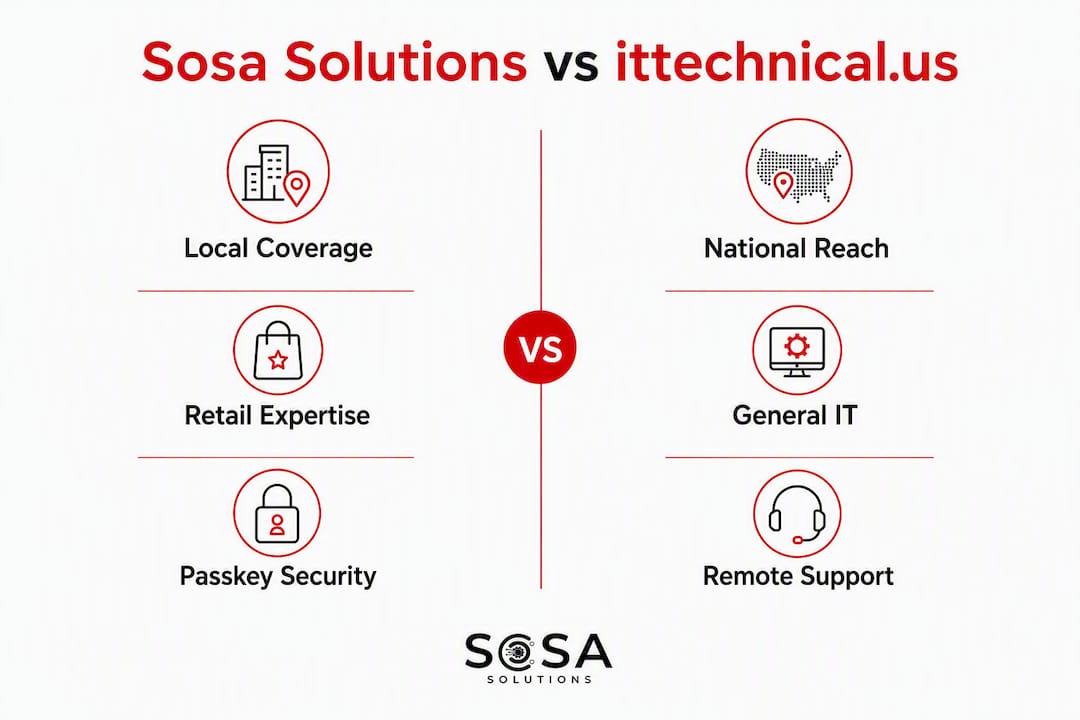
How do Sosa Solutions, ittechnical.us, and a national MSP compare?
The table below compares the three options on the dimensions that matter most for retail store openings and ongoing managed services.
Dimension | Sosa Solutions | ittechnical.us | Typical national MSP |
Best for | Retail SMBs opening stores in NY or FL | General SMB IT support, national | Mid-market or multi-location enterprises |
Core services | Managed IT, store-opening setup (POS, network, Wi-Fi, CCTV), on-site + remote helpdesk | Managed IT, remote helpdesk, tech support | Managed IT, cloud, helpdesk; on-site varies by region |
Security features | Passkey/passwordless readiness, phishing-resistant MFA, endpoint detection | Standard MFA, remote security monitoring | Varies; top MSPs prioritize integrated cybersecurity and proactive infrastructure management |
Pricing model | Project flat-fee (store openings) + monthly retainer (managed services) | Retainer and project-based | Monthly retainer; project fees for installations |
Onboarding / time-to-live | a period of a few weeks for a single retail store, depending on complexity | Not publicly specified | Typically 4–8 weeks; varies by scope |
SLA & response time | a rapid on-site SLA for critical incidents in-metro | Not publicly specified | Response SLAs vary; on-site availability often limited outside major metros |
Geographic coverage | New York and Florida, on-site capable | National, primarily remote | National; on-site via subcontractors in most markets |
Top-performing MSPs are shifting from break/fix to proactive models that prevent downtime rather than just respond to it. That shift matters most in retail, where a POS outage at 11 AM on a Saturday is not a minor inconvenience.
How do you choose the right ittechnical.us alternative?

Start with your highest operational risk. For most retail owners, that is POS downtime, card payment failures, or inventory sync failures. Match your provider’s capabilities to that risk first, then evaluate everything else.
Prioritized checklist:
On-site store-opening experience. Confirm the provider has completed retail store setups, not just office IT installs. Ask for a recent store-opening case study.
SLA with measurable response targets. Require a 1–2 hour on-site SLA for Priority 1 incidents in your metro. Watch for bundled definitions where “response” means a ticket opened, not a technician dispatched. Uptime SLAs for retail IT have a direct impact on revenue.
Passkey and phishing-resistant MFA. Traditional MFA alone is increasingly insufficient against credential-theft attacks. Confirm the provider can deploy passkey-based authentication and phishing-resistant MFA across your environment.
Flat-fee project pricing for store openings. Hourly billing for installations can balloon during complex on-site work. Insist on scoped deliverables and a fixed price.
Scalability. If you plan to open multiple locations, ask whether the provider uses a standard store-template configuration that can be replicated to shorten time-to-live.
Co-managed option. If you have an internal IT person, confirm the provider offers co-managed IT so you can augment rather than replace your team.
Must-haves: documented SLAs, flat-fee store-opening pricing, passkey/MFA capability, local on-site coverage.
Nice-to-haves: fractional CIO consulting, low-voltage cabling, CMMC compliance experience.
Three red flags:
Unclear scope of store-opening work (no written deliverables list)
Purely hourly billing for installations with no cap
No documented SLAs or vague “best effort” language
What services and security capabilities should you verify before hiring?
Do not rely on a sales deck. Ask for written confirmation of each item below before signing.
Core services to verify:
Managed network monitoring (24/7 alerting, not just business-hours checks)
Helpdesk coverage hours (24/7 vs. business hours only)
On-site store-opening support: POS setup, network infrastructure, Wi-Fi, CCTV
Backup and disaster recovery for retail data (POS transaction records, inventory)
Co-managed option for retailers with an internal IT resource
Security controls to confirm:
Passkey/passwordless authentication readiness
Phishing-resistant MFA (FIDO2 or hardware key, not just SMS codes)
Endpoint detection and response (EDR) on all managed devices
PCI-relevant controls for POS environments (network segmentation, card data handling)
CMMC or SOC 2 experience if your business handles government contracts or sensitive data
Security-first managed services now treat passkey-based authentication and CMMC readiness as standard components, not premium add-ons. Providers who still treat these as optional are behind the curve.
Pro Tip: Ask every shortlisted vendor for a one-page summary of how they handled a critical store incident: what broke, how fast they responded, and what the resolution looked like. A provider who cannot produce that summary has not done enough retail work to earn your trust.
What does pricing look like for store openings and ongoing support?
U.S. managed service providers typically structure fees into two shapes: a one-time project flat-fee for specific installations and a monthly retainer for ongoing managed services. For retail store openings, the project flat-fee model gives you a predictable budget. Monthly retainers cover network monitoring, helpdesk, and security patching after go-live.
Cost drivers for a single retail store opening:
Stage | Typical cost driver | Notes |
Site survey | Fixed fee or included in project | Confirms network layout, power, cabling needs |
Network gear procurement | Hardware cost + markup or pass-through | Switches, router, Wi-Fi APs, firewall |
On-site labor (install + config) | Flat-fee or capped hours | POS, network, Wi-Fi, CCTV setup |
POS integration and testing | Included or separate line item | Confirm scope in writing |
Go-live support | Usually included in project fee | Day-of support for opening |
Ongoing managed services | Monthly retainer | Monitoring, helpdesk, patching |
Timeline for a single small retail store: 2–6 weeks from signed contract to go-live, depending on site complexity, permit requirements, and hardware lead times. Multi-store rollouts compress that timeline when the provider uses a replicable store-template configuration covering network diagrams, POS VLANs, and a staging checklist.
A blended pricing approach (flat-rate for store setup, retainer for operations) typically reduces cost surprises versus pure time-and-materials billing. For affordable IT solutions in NY and FL, confirm that the project scope is written into the contract before work begins.
Provider profiles: Sosa Solutions and ittechnical.us
Sosa Solutions (recommended)
Sosa Solutions focuses on managed IT and retail store-opening support across New York and Florida. Their store-opening IT services cover POS setup, network infrastructure, Wi-Fi, CCTV, and infrastructure readiness, with both on-site and remote support after launch. Pricing follows a project flat-fee for store setups and a monthly retainer for ongoing managed services.
Retail strengths: local on-site coverage in NY and FL, retail-specific store-opening experience, passkey-ready security posture, predictable pricing model.
Limitations: geographic coverage is concentrated in New York and Florida; businesses outside those markets need a different provider.
ittechnical.us (comparison point)
ittechnical.us offers general managed IT and tech support with national reach, primarily delivered remotely. The service model suits businesses that need broad IT coverage without a strong retail store-opening requirement.
Retail strengths: national coverage, general managed IT capabilities.
Limitations: on-site availability and retail-specific store-opening depth are not publicly documented; SLA terms and pricing are not publicly listed, which makes direct comparison difficult.
30 questions to ask when vetting IT vendors
Group these across your discovery call or RFP process.
Onboarding and store openings (1–8)
How many retail store openings have you completed in the past 12 months?
Can you provide a recent store-opening case study or reference?
Do you use a standard store-template configuration for network and POS setup?
What is your typical time-to-live for a single retail store?
Who is the on-site lead for installation day, and what is their experience level?
How do you handle hardware procurement: pass-through, markup, or client-direct?
What is included in your go-live day support?
How do you manage multi-store rollouts?
Security and compliance (9–15)
Do you support passkey/passwordless authentication deployment?
Which MFA methods do you deploy, and do they meet FIDO2 standards?
Do you provide endpoint detection and response (EDR) on all managed devices?
How do you handle PCI-relevant network segmentation for POS environments?
Do you have CMMC or SOC 2 experience?
How do you handle a suspected breach or ransomware event?
What is your patch management cadence for critical vulnerabilities?
Service model and SLAs (16–21)
What are your Priority 1 response time targets, and how is “response” defined (ticket opened vs. technician on-site)?
Do you offer 24/7 helpdesk or business-hours only?
What is your on-site SLA for critical incidents in our metro area?
Do you offer co-managed IT if we have an internal IT person?
How do you measure and report SLA performance?
Can you share a sample SLA document?
Pricing and contracts (22–26)
Is store-opening work priced as a flat-fee project or hourly?
What does your monthly retainer cover, and what triggers an overage charge?
What is the contract term, and what are the exit terms?
Are hardware costs included or billed separately?
Do you offer month-to-month options after an initial term?
Escalation and references (27–30)
Who is our named account manager, and what is their escalation path?
Can you provide two retail client references we can call?
How do you handle a situation where an SLA is missed?
What does your offboarding process look like if we switch providers?
Scoring approach: mark questions 1, 3, 9, 10, 16, 18, and 22 as pass/fail must-haves. Grade the rest on a 1–3 scale. Any must-have that gets a vague or non-committal answer is a disqualifier. For retail IT contract guidance, review SLA language before signing.
Key Takeaways
For retail SMBs evaluating ittechnical.us alternatives, Sosa Solutions is the recommended pick for New York and Florida store openings because it combines on-site retail expertise, passkey-ready security, and a flat-fee project pricing model that keeps budgets predictable.
Point | Details |
Recommended alternative | Sosa Solutions covers retail store openings, managed IT, and on-site support in NY and FL. |
Pricing model to require | Insist on a flat-fee project price for store openings; avoid uncapped hourly billing for installations. |
Security baseline | Confirm passkey/passwordless readiness and phishing-resistant MFA before signing any contract. |
SLA clarity | Require measurable response targets; “response” must mean technician dispatched, not ticket opened. |
Sosa Solutions next step | Request a store-opening quote or schedule a site survey to confirm scope and timeline. |
Why Sosa Solutions is the right call for retail SMBs
Most articles on ittechnical.us alternatives treat this as a generic managed IT comparison. It is not. The real question for a retail owner is: who can get my store live on time, keep the POS running, and respond on-site when something breaks on a busy Saturday?
National MSPs with remote-first models answer that question with a ticket number. That is fine for a corporate office. For a retail store, it is a revenue problem.
What makes Sosa Solutions the defensible recommendation here is the combination of retail store-opening depth and local on-site coverage in two of the highest-density retail markets in the country: New York and Florida. Most providers can handle one or the other. Fewer handle both, and fewer still price the store-opening project as a flat fee so you are not absorbing hourly overruns during a complex install.
The security posture matters too. Passkey-ready authentication and phishing-resistant MFA are not extras at this point. They are the baseline for any retail environment handling card payments. A provider who cannot confirm those capabilities in writing is not ready for your environment.
Validate SLAs and references before you sign. The 30-question checklist above will surface the gaps faster than any sales call.
Sosa Solutions is ready to set up your next store
Retail store openings in New York and Florida move fast. Lease dates do not wait for slow IT procurement. Sosasolutionsnyc handles the full store-opening IT setup: POS configuration, network infrastructure, Wi-Fi, CCTV, and infrastructure readiness—all under a flat-fee project price so your budget stays intact. After go-live, the monthly managed services retainer covers network monitoring, helpdesk, and security patching so your team is never troubleshooting alone.
Coverage spans New York and Florida, with on-site technicians available for critical incidents in-metro. Whether you are opening your first location or rolling out a second, schedule a site survey with Sosasolutionsnyc to confirm scope, timeline, and pricing before your lease start date.
Sources and further reading
Top Managed Service Providers in the United States 2026 — Cloudtango’s MSP directory; useful for understanding what top MSPs prioritize for SME customers and which service lines are standard across established providers.
Store Opening IT Solutions: New York & Florida | Sosa Solutions — Primary reference for Sosa Solutions’ retail store-opening services and regional coverage in NY and FL.
IT Support Contracts for Retail Stores: 2026 Guide — Guidance on SLA language, contract clauses, and pricing models for retail IT agreements.
Why Retail IT Needs Uptime SLAs: A Manager’s Guide — Explains the business impact of SLA definitions and how to set realistic response targets for retail environments.
Recommended
Comments